Madhya Pradesh · September
Madhya Pradesh Hunger Field Survey
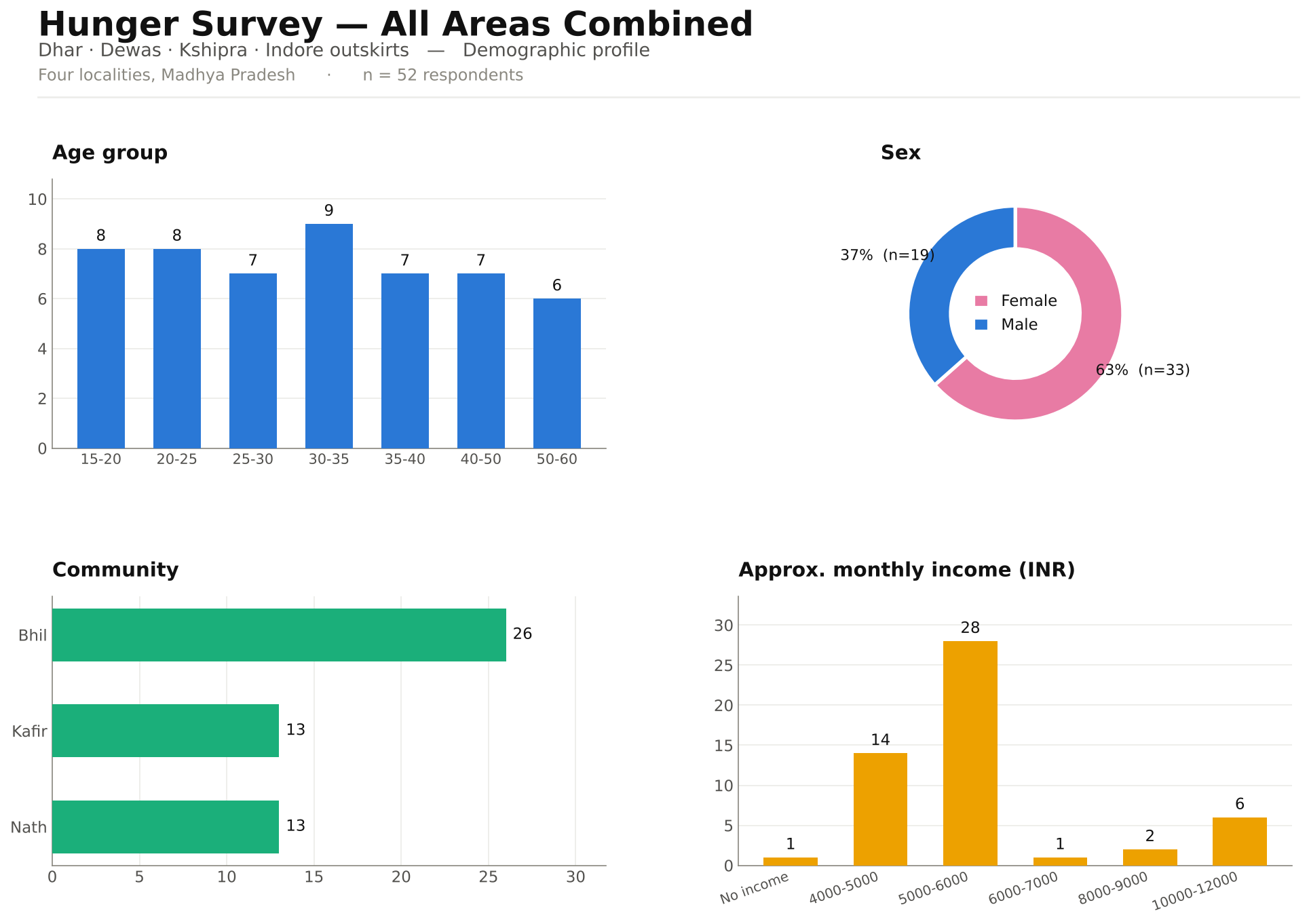
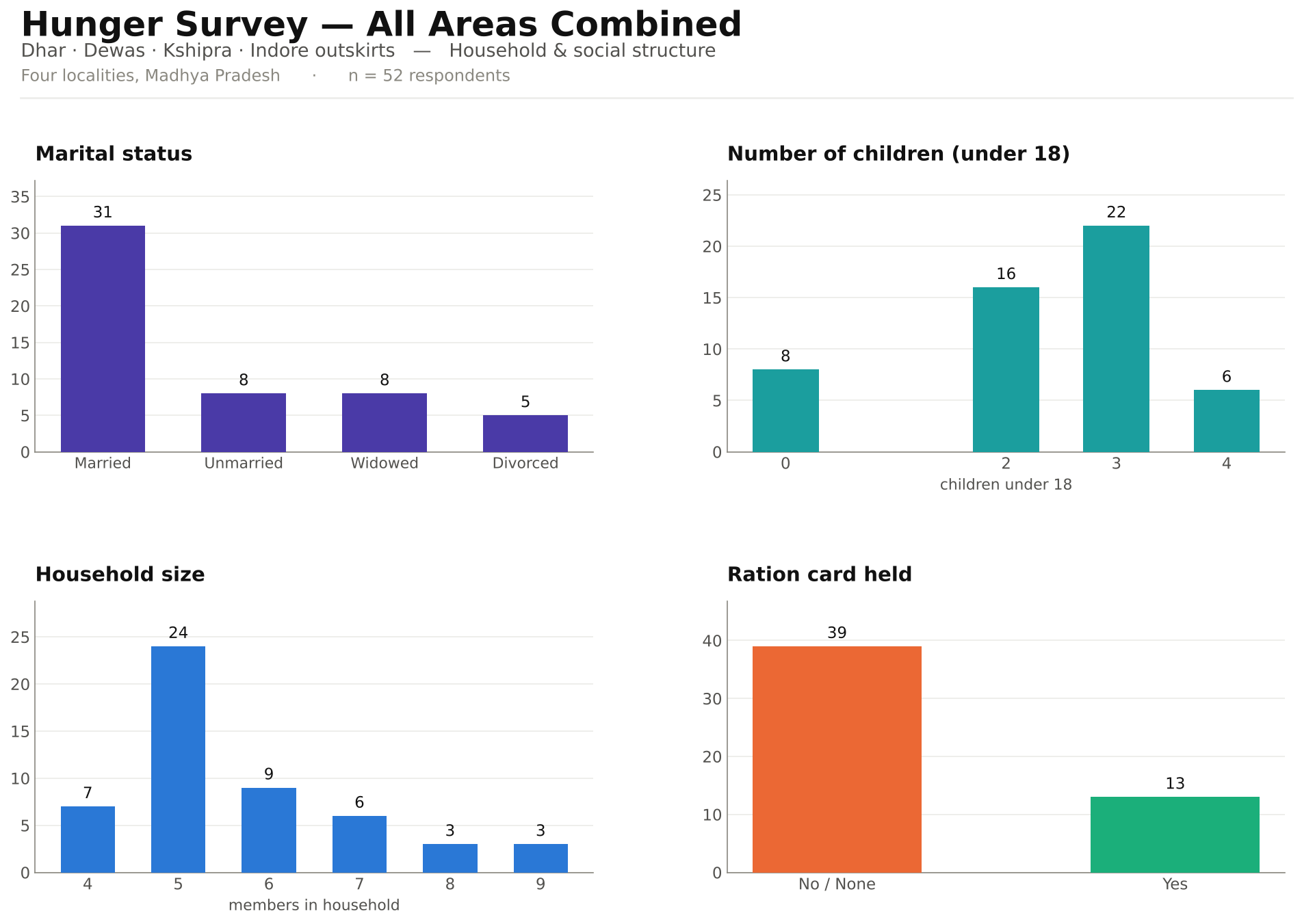
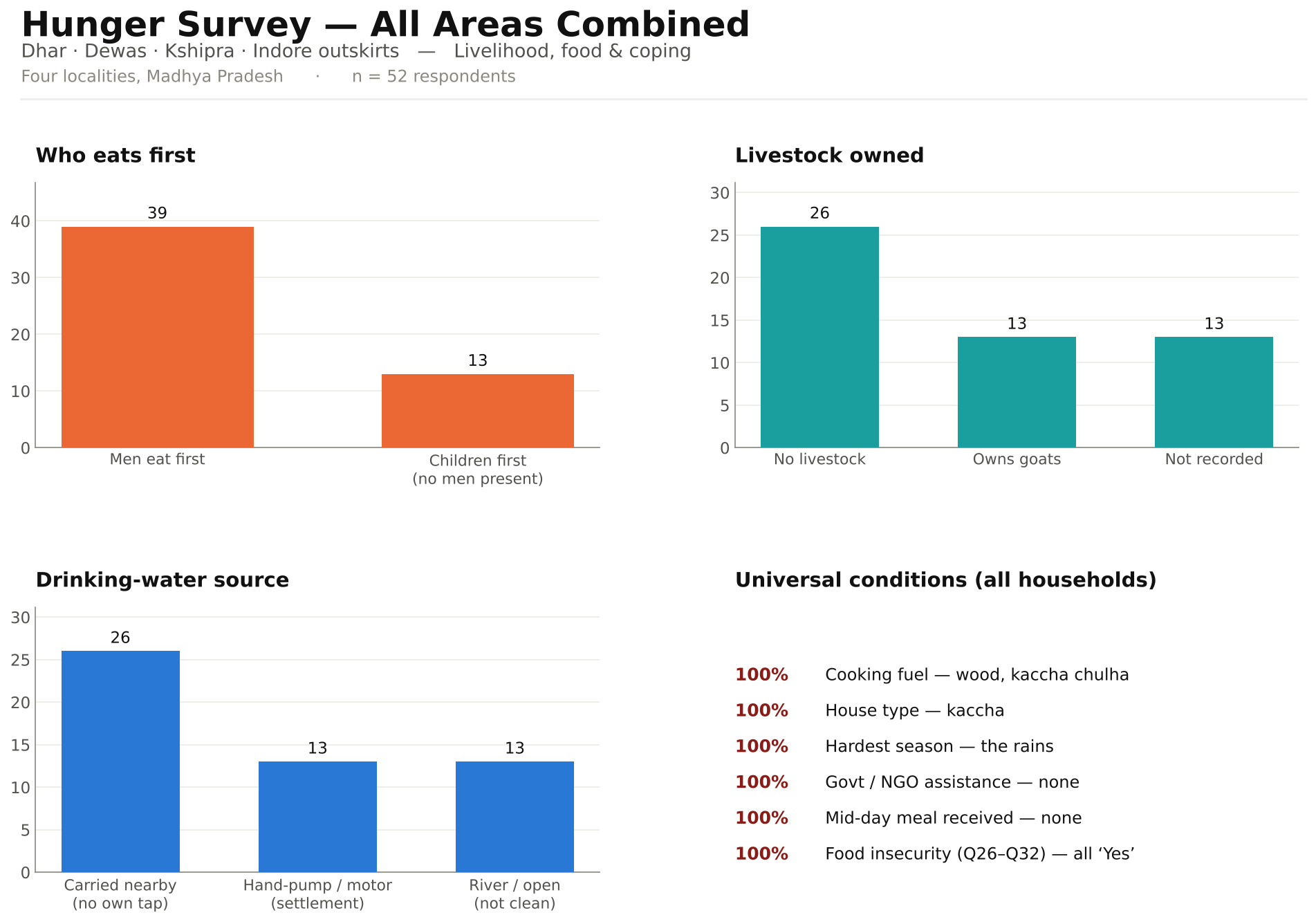
Across the four localities of Dhar, Dewas, Kshipra and the margins of Indore, fifty-two households were surveyed in equal measure, thirteen to each place, and from their testimony there emerges a portrait less of scarcity than of its permanence. These are households of the Bhil, the Kafir and the Nath — three communities whom circumstance has pressed to the same low ground. Women form nearly two-thirds of those who spoke, and it is upon them that the labour of the household, and frequently its sole income, has come to rest. What the figures disclose is a poverty remarkable chiefly for its uniformity. Earnings gather, with little deviation, about five to six thousand rupees a month; the households are large, some six souls apiece, and burdened commonly with two or three children; and every dwelling, without exception, is of unbaked earth, its hearth fed with wood. Of the fifty-two, but thirteen hold a ration card; the remaining thirty-nine possess none. No family owns land. No woman brought anything into her marriage. The order of eating is, in all but one quarter, a settled hierarchy in which the men are served and the women wait. The instrument’s final section renders its verdict without dissent: in every household, by every measure, the answer is the same. All have had recourse to meaner and fewer foods; all have curtailed their meals; in all of them the children have gone to their beds hungry — and this not upon some solitary evening but through five days and more within the month. The conclusion to be drawn is sombre and unambiguous: here hunger is not an episode but a condition. It does not distinguish between one household and the next, for it has visited them all alike; and its weight descends most heavily upon the women and the children, who in the economy of the household eat last, and least.
- Conducted by
- -
- Location
- Madhya Pradesh
- Respondents
- 52 households
FINDINGS
The survey of fifty-two households across Dhar, Dewas, Kshipra and the outskirts of Indore yielded findings of unusual consistency. Chief among them is that food insecurity in these communities is not intermittent but total: in every household surveyed, and by every indicator of the standard measure, respondents affirmed that they had relied upon a narrower range of food, curtailed or forgone meals, and sent their children to bed hungry — not on an isolated occasion but on five days or more within the preceding month. This universality was itself the most significant result, for it establishes hunger here as a structural condition rather than a seasonal misfortune. The second finding concerns its distribution within the home: in thirty-nine of the fifty-two households the men were fed first and the women last, so that scarcity, where it fell, fell disproportionately upon women and children. A third set of findings traces the absence of any cushion against want — no household owned land, almost none possessed livestock beyond a few goats in Dewas, incomes clustered immovably at five to six thousand rupees against households of some six persons, and every dwelling was of unbaked earth with a wood-fed hearth. Finally, and most tellingly, the machinery of relief was found to be either absent or inert: no family received assistance from the government or any organisation, no child received a mid-day meal, and — most pointed of all — the thirteen households near Indore that did hold ration cards proved no less hungry than the thirty-nine that held none, indicating that formal entitlement had not, in practice, translated into food upon the table.
FIELD NOTES
- 01The survey was conducted during the monsoon, and the weather bore materially upon both the fieldwork and its findings. Rain fell heavily and often throughout the period of visits, frequently reducing the unmetalled approach roads to mud and rendering several hamlets difficult to reach; interviews were on more than one occasion suspended or shortened as households and interviewer alike took shelter. The timing was not incidental to the subject: respondents in every locality named the rains as the hardest season of the year, the months in which labour is scarcest, wages most irregular, and food most difficult to procure — so that the survey happened to coincide with the very period of greatest privation it sought to document. The condition of drinking water was conspicuous in the wet season, the open and riverine sources near Kshipra running visibly turbid, which lends weight to the reports of frequent illness. Interviews were conducted gently and without coercion, in keeping with the instrument’s own instruction that participation was voluntary; consent was recorded by signature or thumb-impression before each began. Respondents were, on the whole, forthcoming, though a certain reticence attended questions touching upon hunger among the children, and several women answered these only after reassurance. Rapport was eased by conducting the conversations in the respondents’ homes and at their own pace. It should be noted for the record that the sample was one of convenience rather than strict randomisation, and that within several localities the households approached were connected by kinship — a circumstance that may bear upon the uniformity of the responses and should temper any claim to statistical representativeness.
PHOTOS