Delhi · september 2026
Delhi Hunger Survey
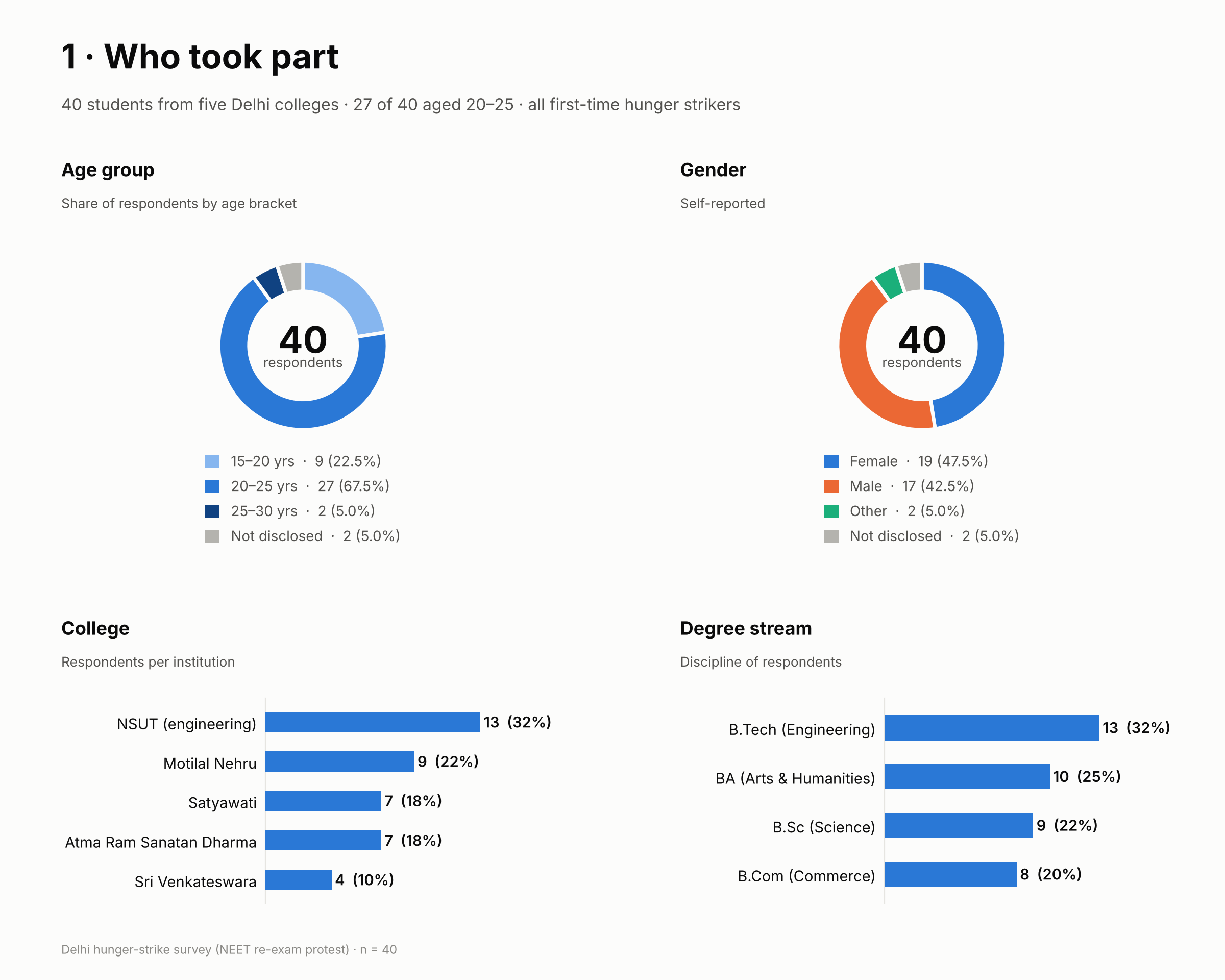
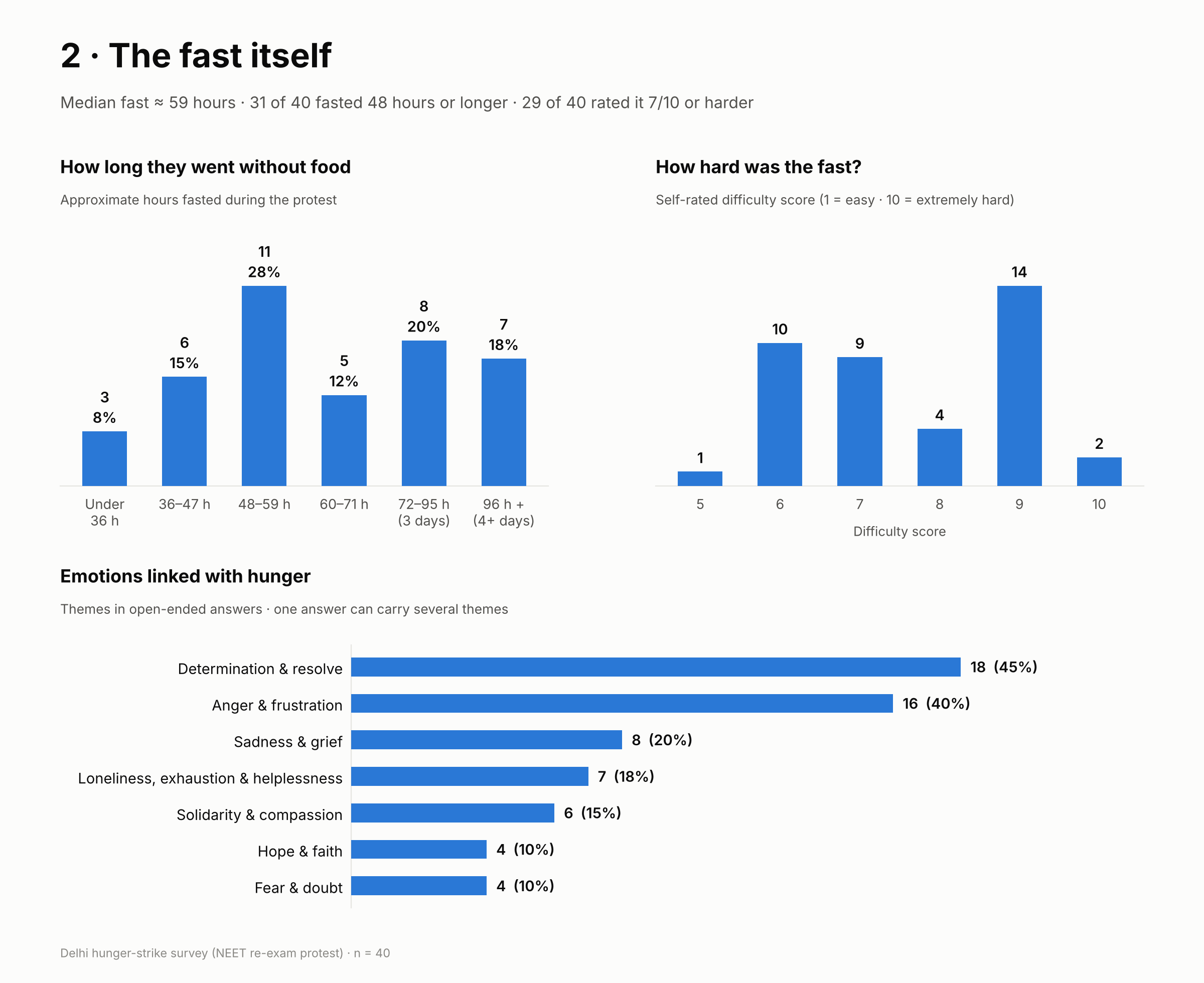
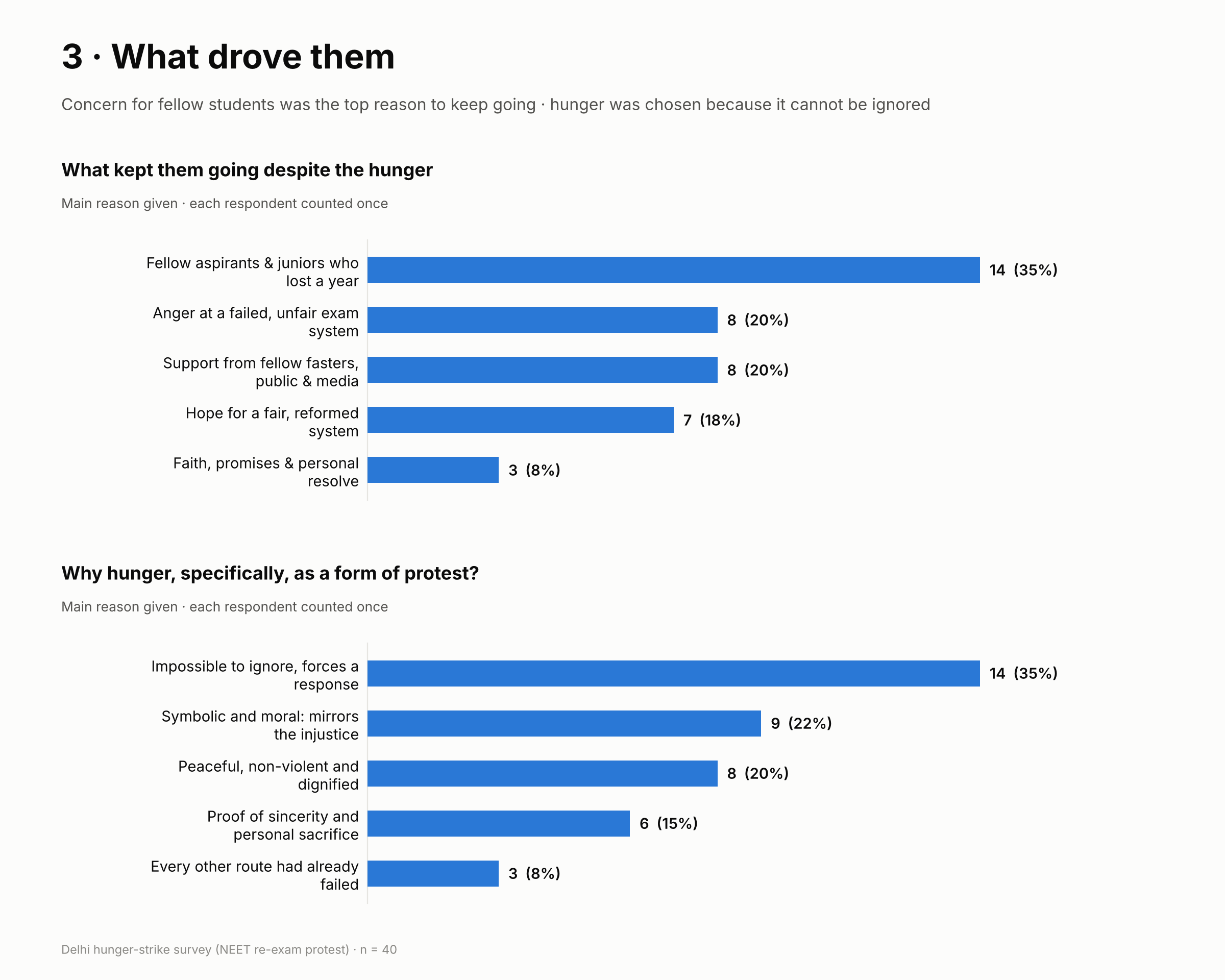
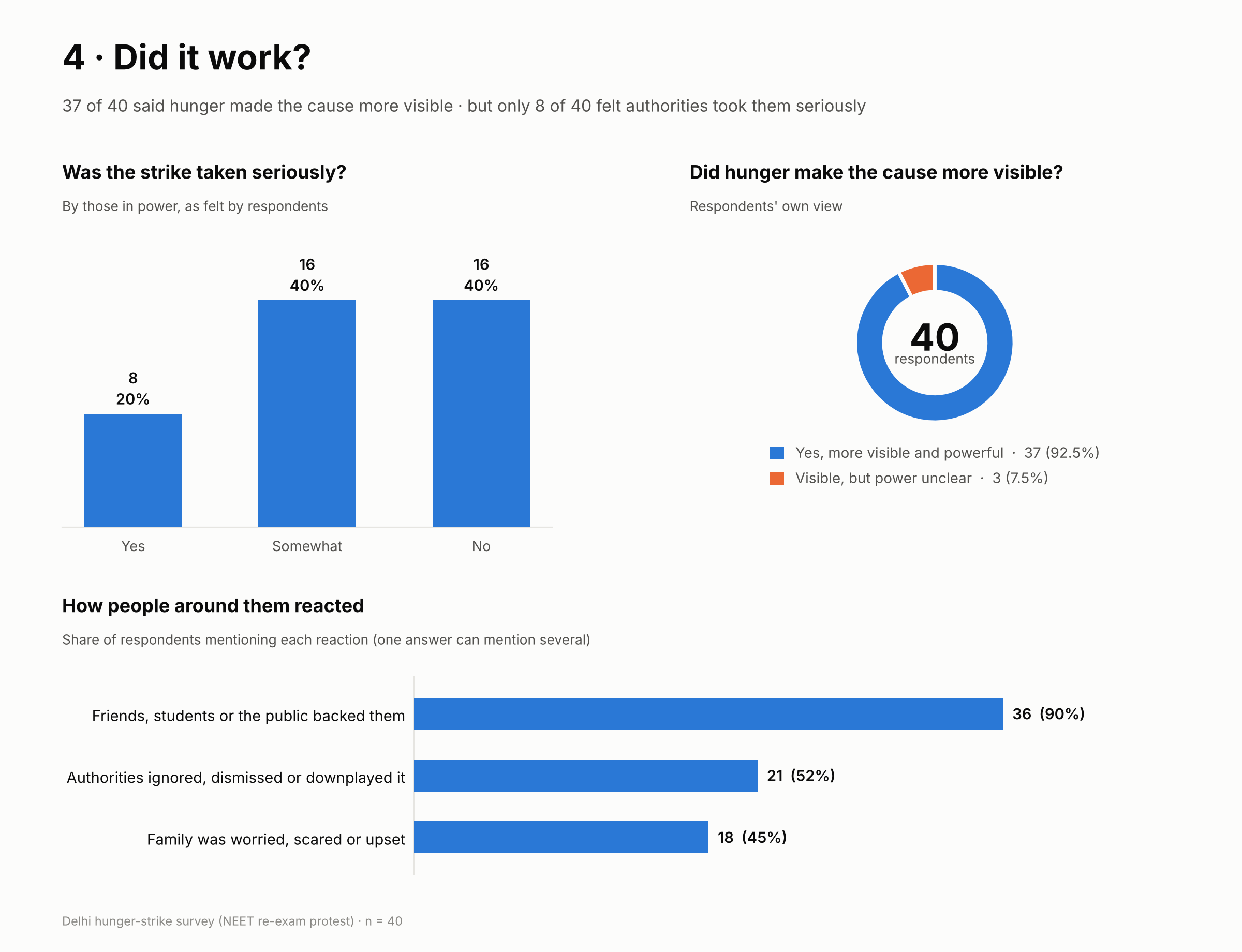
This study examines how students who undertook a hunger strike against the re-examination understood their own act. The protest arose among candidates who were required to resit a national entrance examination, and the survey asks what hunger meant to those who chose it, attending to its sensation, its emotional register and the reasons for adopting abstention as a mode of address, in a South Asian tradition that treats fasting as a form of political speech. The hunger strike is taken here to be a communicative act as well as a physical one: the body, in refusing sustenance, is made to speak where ordinary language has failed. The evidence was gathered through a self-administered online questionnaire of thirty-eight items, created and distributed through Google Forms. The instrument combined demographic and closed questions with a ten-point scale of perceived difficulty and a series of open-ended questions, several of which invited interpretive responses to visual images of hunger. Forty students from five Delhi colleges responded: Netaji Subhas University of Technology, Motilal Nehru College, Satyawati College, Atma Ram Sanatan Dharma College and Sri Venkateswara College. Twenty-seven were aged 20–25, and all forty were fasting in protest for the first time. Closed items were tabulated directly, while the open answers were read closely and coded thematically. The fast proved prolonged and arduous. The median duration was approximately fifty-nine hours, thirty-one respondents abstained for at least forty-eight hours, and the mean self-rated difficulty was 7.7 out of 10. The emotions most frequently named were determination (eighteen respondents) and anger or frustration (sixteen). The students’ motives were notably outward-facing: the largest group (fourteen) cited solidarity with the aspirants and juniors who had lost a year, and an equal number chose hunger because it cannot readily be ignored. Others described it as a symbolic and moral gesture, and as a peaceable one that preserved the dignity of the cause. Visibility was largely achieved. Thirty-seven of the forty judged that the fast had made their cause more visible, and thirty-six reported the support of friends, fellow students or the public. Acknowledgement from authority was another matter. Only eight felt they had been taken seriously, thirty-two answered “somewhat” or “no”, and twenty-one described the authorities as ignoring, dismissing or minimising the protest. Eighteen recalled that their families were anxious or distressed. The results suggest a disjunction between being seen and being answered: abstention secured an audience and a measure of public sympathy, yet it did not, in the students’ account, command a corresponding response from those it addressed. Hunger functions here as testimony, a bodily witness offered where speech had been disregarded, and its efficacy depends on a listener willing to hear. The sample is small, non-random and self-reported, so the findings describe these forty respondents and cannot be generalised. Fasting durations were estimated from free-text answers, and the thematic coding was undertaken by a single coder, so the counts are interpretive. The responses form a sample dataset compiled to illustrate the survey instrument and its analysis.
- Conducted by
- -
- Location
- Delhi
- Respondents
- 40 households
FINDINGS
The survey indicates that the students conceived of their fast as a form of public address, a language adopted once ordinary speech had failed to secure a hearing. The fast was demanding by any measure: a median of about fifty-nine hours, thirty-one respondents abstaining for at least forty-eight hours, and a mean difficulty rating of 7.7 out of 10. Its stated motives were largely outward-facing. The most frequent was solidarity with fellow aspirants who had lost a year (fourteen of forty), and the most frequent reason for choosing hunger over other methods was that it cannot easily be ignored (also fourteen). In terms of consequence, the protest succeeded in making the cause visible (thirty-seven of forty) and in attracting the support of friends, peers and the public (thirty-six). It was far less successful in securing acknowledgement from authority: only eight respondents felt they had been taken seriously, thirty-two answered “somewhat” or “no”, and twenty-one described the authorities as dismissive. The central finding is accordingly a disjunction between being seen and being answered.
FIELD NOTES
- 01The data were gathered by means of a self-administered online questionnaire created in Google Forms, comprising thirty-eight items. These combined demographic and closed questions with a ten-point difficulty scale and open-ended questions, several of which invited responses to visual prompts concerned with hunger. The platform time-stamped each submission, and the responses were exported to a spreadsheet with one row per respondent, forty in all. The contact field was optional, and ten respondents chose to leave it blank. The open-ended answers were written in an informal register, with occasional lapses in spelling and grammar, and I have retained them as written. Closed answers were tabulated directly. Fasting durations were estimated from free-text statements such as “about forty-eight hours”, and the themes reported for emotion, motivation, choice of hunger and reaction were derived by reading and coding the open responses. Those counts are interpretive, and a second coder might draw the boundaries between themes somewhat differently. Given the small, non-random and self-reported sample, the findings describe these forty respondents and should not be generalised beyond them.
PHOTOS